
Thursday, December 25, 2014

Friday, December 12, 2014

Tuesday, October 28, 2014
Mixed Crop Prospects Following Variable Australia Winter Conditions
AUSTRALIA - After a generally favourable start to the 2014–15 winter crop season, different regional conditions have resulted in mixed crop prospects, according to the latest release of Australian Crop Report by the Australian Bureau of Agricultural and Resource Economics and Sciences (ABARES).

Chief Commodity Analyst for ABARES, Jammie Penm, said while there were favourable conditions in South Australia other regions fared less well.
"The outlook for winter crops in South Australia is positive, reflecting average rainfall during winter and high levels of soil moisture. Generally dry conditions prevailed in many regions of the eastern states and Western Australia," Mr Penm said.
"In New South Wales, seasonal conditions have been highly variable but on average, crop yields are expected to improve from below average yields in 2013–14.
"Seasonal conditions have generally been dry in Victoria over winter, particularly in the major growing regions of the Mallee and the Wimmera. In Queensland, rainfall was below average between May and July but above average in August."
The Bureau of Meteorology's latest three-month rainfall outlook for spring does not indicate a strong tendency for either wetter or drier than normal conditions across the major cropping regions in Queensland, South Australia and Western Australia. In most of New South Wales and parts of central Victoria, conditions are likely to be drier than normal.
"As a whole, Australia’s total winter crop production is forecast to fall by 12 per cent in 2014–15 to 38.6 million tonnes, which is a slight downward revision from the ABARES June 2014 forecast," Mr Penm said.
"With major winter crops of wheat, barley and canola forecast to decline in 2014-15, sufficient and timely rainfall during spring will be critical, particularly in areas where soil moisture levels are low."
Thursday, September 25, 2014
Tips for Weeding Your Perennials
To keep your garden perennials looking their best, you need to control weeds. Weeds rob the soil of nutrients that your flowers could be using. Controlling weeds in your flower beds isn’t difficult. Like flowers, weeds come in two main groups — annuals and perennials:
 The annuals form staggering quantities of seed; some produce up to 500,000 per plant. Pull annuals out of your garden before they form seed.
Perennial weeds are harder to control. They seem to live forever and expand by sending out roots or running stems for several feet in every direction. These weeds want to conquer the world. Pulling and digging at them appears to make them mad; they seem to spread even faster in response. Perennial weeds also form seeds, so don’t ever let them get to this stage. Unfortunately, mulch doesn’t stop their roots or runners. The most effective way to dispatch perennial weeds is with an herbicide.
When perennial weeds pop up in an established flower border, getting the herbicide on the weed but not the flowers is a challenge. Use a plastic bag to isolate the weed. Here’s how:
1. Cut a hole large enough to fit the weed through in the bottom of a plastic bag.
2. Pull the entire weed through the hole in the bottom of the bag.
3. Place a stone in the bottom of the bag to hold it in place.
4. Carefully spray herbicide into the top of the bag.
If you accidentally spray or spill some herbicide on adjoining flowers, immediately rinse them off with water.
5. Seal the top of the bag with a twist-tie and leave the bag in place until the weed is dead.
If your soil is loose and crumbly, a light tug is probably all you need to yank out the most stubborn weed. But in dense soil, what usually happens is that you tug at the weed and the top comes off neatly in your hand. The roots happily grow a new top, and the next time you look, the weed is back, looking refreshed and smug! To kill most weeds, you must get the root. Here’s the simplest technique to do so:
1. Slip the blade of your hand trowel into the ground straight down, next to the main root of the weed.
2. Push the trowel blade firmly against the root to loosen it.
3. Grab hold of the base of the leaves and pull.
Most of the time, this action gets you the whole weed — roots and all.
Perennial weeds are harder to control. They seem to live forever and expand by sending out roots or running stems for several feet in every direction. These weeds want to conquer the world. Pulling and digging at them appears to make them mad; they seem to spread even faster in response. Perennial weeds also form seeds, so don’t ever let them get to this stage. Unfortunately, mulch doesn’t stop their roots or runners. The most effective way to dispatch perennial weeds is with an herbicide.
When perennial weeds pop up in an established flower border, getting the herbicide on the weed but not the flowers is a challenge. Use a plastic bag to isolate the weed. Here’s how:
1. Cut a hole large enough to fit the weed through in the bottom of a plastic bag.
2. Pull the entire weed through the hole in the bottom of the bag.
3. Place a stone in the bottom of the bag to hold it in place.
4. Carefully spray herbicide into the top of the bag.
If you accidentally spray or spill some herbicide on adjoining flowers, immediately rinse them off with water.
5. Seal the top of the bag with a twist-tie and leave the bag in place until the weed is dead.
If your soil is loose and crumbly, a light tug is probably all you need to yank out the most stubborn weed. But in dense soil, what usually happens is that you tug at the weed and the top comes off neatly in your hand. The roots happily grow a new top, and the next time you look, the weed is back, looking refreshed and smug! To kill most weeds, you must get the root. Here’s the simplest technique to do so:
1. Slip the blade of your hand trowel into the ground straight down, next to the main root of the weed.
2. Push the trowel blade firmly against the root to loosen it.
3. Grab hold of the base of the leaves and pull.
Most of the time, this action gets you the whole weed — roots and all.
Thursday, September 4, 2014
How to Choose Plants for Your First Vegetable Garden
Growing a vegetable garden is one of the most rewarding activities you can do for your family. Home grown vegetables taste better and have more nutrients than store bought veggies since you can pick them the same day you want to use them or even can them when they are at their ripest.

There are an infinite number of veggies that you can grow in your backyard or even just on your patio or balcony. Here are a few perfect plants to grow in your first veggie garden:
Green beans are an easy plant to grow in your first vegetable garden. The only hard part is knowing if the plants or seeds you have are a bush variety or are climbers. If they are bush beans, then you don’t need to do anything other than plant them a half an inch under the soil and water in well. If they are climbers, you will need to add a trellis or plant them up against a wall so that they can climb up. Green beans start to produce on average 45 days after you plant them.
Cucumbers or zucchini are also very easy vegetables to grow. When planting the seed, make sure it is buried at least 3x the diameter of the seed. Since these tend to be large seeds, make a hole half an inch down and cover it up. In a week the plant will be about an inch high already! If transplanting, make the hole the size of the root ball and gently tease out the roots and place it in the hole then water it in well. These plants can get quite large so plant 12 inches apart. It should start to set out fruit after 30 days and you can be eating cucumbers and zucchini in as little as 60 days.
Tomatoes are another plant that are not too difficult to grow. There are so many varieties to choose from and selecting what you want to grow might be the hardest part! The key to tomatoes is to remember they will not set fruit if the daytime temperatures get over 90 degrees. If you are in the Southwest, plant tomatoes in February and after Mother’s Day in most areas of the Midwest and Northern states. Make sure that the tomatoes are not on the ground as too many insects and critters will eat them before you do! You can harvest the tomatoes when they are still green or you cut some of the vine with it and allow them to continue to ripen on the vine in your kitchen. (technically tomatoes are fruit but in cooking they are usually used as a savory ingredient so we included them as a veggie for the purposes of this post.)
Both spinach and leaf lettuce are also quite easy to grow for the beginning gardener. You can mix the seed and spread the mixture over an area and cut the baby leaves after they are a couple inches tall. This successive sowing will keep new leaves growing each week and allows you to have fresh greens until the weather gets too warm!
These are just a few of the perfect plants to grow in your first veggie garden. There are many more just waiting for you to try and see if you have a green thumb too!
There are an infinite number of veggies that you can grow in your backyard or even just on your patio or balcony. Here are a few perfect plants to grow in your first veggie garden:
Green beans are an easy plant to grow in your first vegetable garden. The only hard part is knowing if the plants or seeds you have are a bush variety or are climbers. If they are bush beans, then you don’t need to do anything other than plant them a half an inch under the soil and water in well. If they are climbers, you will need to add a trellis or plant them up against a wall so that they can climb up. Green beans start to produce on average 45 days after you plant them.
Cucumbers or zucchini are also very easy vegetables to grow. When planting the seed, make sure it is buried at least 3x the diameter of the seed. Since these tend to be large seeds, make a hole half an inch down and cover it up. In a week the plant will be about an inch high already! If transplanting, make the hole the size of the root ball and gently tease out the roots and place it in the hole then water it in well. These plants can get quite large so plant 12 inches apart. It should start to set out fruit after 30 days and you can be eating cucumbers and zucchini in as little as 60 days.
Tomatoes are another plant that are not too difficult to grow. There are so many varieties to choose from and selecting what you want to grow might be the hardest part! The key to tomatoes is to remember they will not set fruit if the daytime temperatures get over 90 degrees. If you are in the Southwest, plant tomatoes in February and after Mother’s Day in most areas of the Midwest and Northern states. Make sure that the tomatoes are not on the ground as too many insects and critters will eat them before you do! You can harvest the tomatoes when they are still green or you cut some of the vine with it and allow them to continue to ripen on the vine in your kitchen. (technically tomatoes are fruit but in cooking they are usually used as a savory ingredient so we included them as a veggie for the purposes of this post.)
Both spinach and leaf lettuce are also quite easy to grow for the beginning gardener. You can mix the seed and spread the mixture over an area and cut the baby leaves after they are a couple inches tall. This successive sowing will keep new leaves growing each week and allows you to have fresh greens until the weather gets too warm!
These are just a few of the perfect plants to grow in your first veggie garden. There are many more just waiting for you to try and see if you have a green thumb too!
Thursday, July 17, 2014
Brabant horses
The Brabant was bred with great care to suit the traditional agricultural sills of Belgium, its climate, its rich, heavy soil and the economic and social reliance upon the land. Known as the Belgian Draft Horse in Europe, the Brabants take their name from the area of Belgium where it was developed.
The Brabant breed is ancient and likely to be directly descended from the even older Ardennais an therefore from the primitive foundation of the European heavy horse breed the Forest or Diuvial Horse. Thee massive horses were known to the Romans and received honorable mention in Julius Caesar's De Bello Gallico as most willing and untiring workers.

In the Middle Ages, the Brabant was called the Flanders Horse and was instrumental in the evolution of the English great Horse and later, in the development of the Shire. It was the basis of the Clydesdale and had a large effect upon the Suffolk Punch as well as the Irish Draught Horse.
Principally bred in Brabant, these horses have been distinguished by that name, although they are also referred to as race de trait Belge. The breeders of this horse produced exceptional qualities through stringent selection, excluding foreign blood and occasionally inbreeding.
The Brabant is thick set and compact. The Colosses de la Mehaique line is particularly noted for the great strength of the short back and loins. Brabants stand between 16.2 and 17 hands.
The head is small in proportion to the body, square and somewhat plain, but the expression is intelligent and kindly. The profile is straight or slightly concave, the ears small. A short, thick, powerful neck joins withers and shoulders of similar proportions making the horse ideal for every sort of heavy draft purpose.
Power is the hallmark of this massive breed and it is exemplified in the deep girth and compact body that goes with the Brabant traditional strength of constitution. The breed is noted for the extreme strength and hardness of its short limbs. Soundness of limb was a feature in all of the three principal lines.
The huge, powerful quarters of the Brabant are distinctively rounded and the croup is characteristically double muscled. The flanks are often slightly hollow. Short, extremely strong legs usually terminate in a good deal of feather. The hooves are of medium size and well formed. Colors vary from line to line. Bays, duns and grays occur, but red roan with black points, sorrels and chestnuts predominate.
The Brabant was bred also in Denmark, Luxembourg and Germany. While little known in Britain it has developed in America as the now famous Belgian with somewhat different conformation and is predominantly chestnut with flaxen manes and tails. The American horse is taller, more stylish and has more slope to the shoulder than does the original Brabant of Europe. In various countries in Europe the breed is known by different names. In northern Belgium, the name is Belgisch Trekpaard, while in southern Belgium it is the Cheval de trait Belge or Brabancon. In Holland it is the Nederland Trekpaard and in France, the Cheval Trait du Nord.
In farming and in war the draft horse was indispensable. The decline of interest in large draft horses after World War II nearly meant the extinction of all draft breeds, but numbers are increasing steadily again as interest in owning and driving heavy horses continues to expand, also there is the ongoing meat production market in Europe as well as warmblood horse types based on combining old and new blood. Associations to preserve the older, established Brabant exist in Belgium and American.
Wednesday, July 2, 2014
Benefits of Backyard Rabbit Production
There are many potential benefits that may be realized from backyard rabbit raising. When planning your rabbit enterprise it will be important that you identify a goal and anticipated benefits from farming rabbits. An example of a primary goal is to produce enough rabbits so that the family might consume meat from two fryers per week the year-round. This production goal would require a small backyard operation consisting of about four breeding females (does) and one breeding male (buck). As a backyard activity, and relative to most livestock or outdoor pet animals, rabbits are quiet, odorless and docile animals that often go unnoticed by neighbors, even in residential areas. However, residents living within legal city limits should inquire about possible restrictions concerning the keeping of rabbits by contacting their county health department office.
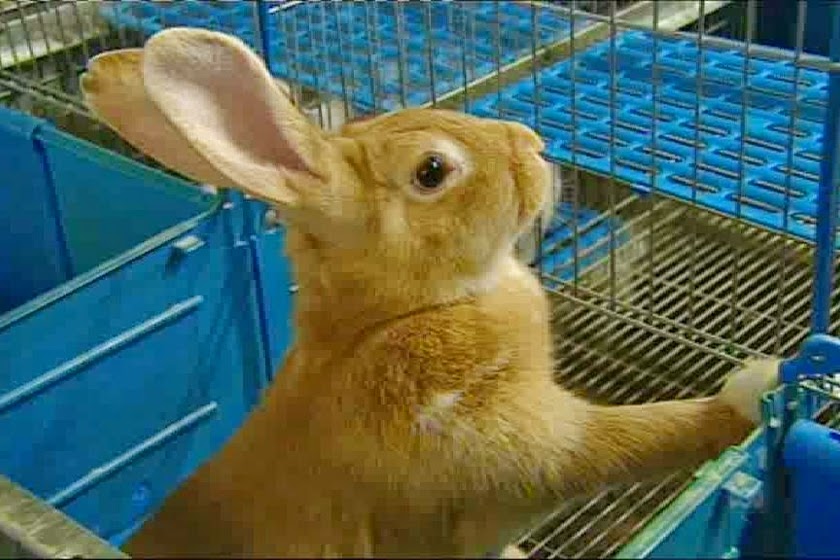
Overall benefits from a backyard rabbit enterprise include: nutritious and wholesome meat; educational experiences for youth; enjoyable occupational activity; rich manure for gardening or flower beds; and potential income generation. According to the USDA, meat from domesticated is an all white meat product that is high in protein and low in fat, sodium and cholesterol as compared to other common meats, such as beef, lamb, pork and poultry. Rabbit meat has been recommended for years by some physicians to their patients with coronary heart conditions.
Educational opportunities for youth, ideally as a 4-H or FFA club project activity, is a wonderful learning experience in the sciences of biology, such as animal behavior, genetics, growth development, and reproductive and digestive anatomy and function. Particularly for a young child, rabbits are easy to handle while representing a minor investment versus a project involving larger livestock. Rabbit raising also teaches responsibility, budgeting costs and returns, care and concern for animals, and the acceptance of livestock as a source of food for humans.
As an occupation of hobby - whether for the young, elderly or any family member - rabbit raising can be an enjoyable and family focused activity. The time or labor required to raise rabbits can be minimally figured to 10 hours per breeding doe in a year. For the backyard operation with four breeding does, this labor input relates to a single work-week (40 hours) per year equivalent, or less than 10 minutes per day. However, many families enjoy spending more time than this with their rabbits.
Rabbit farming compliments the efforts of the serious gardener and flowering plan enthusiast. The manure from rabbits makes excellent compost, rich in organic matter and nutrients, that can produce remarkable garden and flowering results. Commercial redworms or African nitecrawlers grown in rabbit manure produce a superb and fairly odorless organic material that resembles peat moss. Many commercial rabbit producers market both the organic material in bags and bait worms in cartons as a supplemental source of income. For the family that enjoys fishing, one also has a regular supply of bait worms.
The small size of the backyard rabbit enterprise, typically 4 to 5 breeding does, represents steady meat production at minimal investment and operating costs. It is takes little time or money to either down-scale or expand the size of the operation. Labor is ideally shared among family members. These features associate the rabbit enterprise with minimum economic risk.
Overall benefits from a backyard rabbit enterprise include: nutritious and wholesome meat; educational experiences for youth; enjoyable occupational activity; rich manure for gardening or flower beds; and potential income generation. According to the USDA, meat from domesticated is an all white meat product that is high in protein and low in fat, sodium and cholesterol as compared to other common meats, such as beef, lamb, pork and poultry. Rabbit meat has been recommended for years by some physicians to their patients with coronary heart conditions.
Educational opportunities for youth, ideally as a 4-H or FFA club project activity, is a wonderful learning experience in the sciences of biology, such as animal behavior, genetics, growth development, and reproductive and digestive anatomy and function. Particularly for a young child, rabbits are easy to handle while representing a minor investment versus a project involving larger livestock. Rabbit raising also teaches responsibility, budgeting costs and returns, care and concern for animals, and the acceptance of livestock as a source of food for humans.
As an occupation of hobby - whether for the young, elderly or any family member - rabbit raising can be an enjoyable and family focused activity. The time or labor required to raise rabbits can be minimally figured to 10 hours per breeding doe in a year. For the backyard operation with four breeding does, this labor input relates to a single work-week (40 hours) per year equivalent, or less than 10 minutes per day. However, many families enjoy spending more time than this with their rabbits.
Rabbit farming compliments the efforts of the serious gardener and flowering plan enthusiast. The manure from rabbits makes excellent compost, rich in organic matter and nutrients, that can produce remarkable garden and flowering results. Commercial redworms or African nitecrawlers grown in rabbit manure produce a superb and fairly odorless organic material that resembles peat moss. Many commercial rabbit producers market both the organic material in bags and bait worms in cartons as a supplemental source of income. For the family that enjoys fishing, one also has a regular supply of bait worms.
The small size of the backyard rabbit enterprise, typically 4 to 5 breeding does, represents steady meat production at minimal investment and operating costs. It is takes little time or money to either down-scale or expand the size of the operation. Labor is ideally shared among family members. These features associate the rabbit enterprise with minimum economic risk.
Subscribe to:
Posts (Atom)